
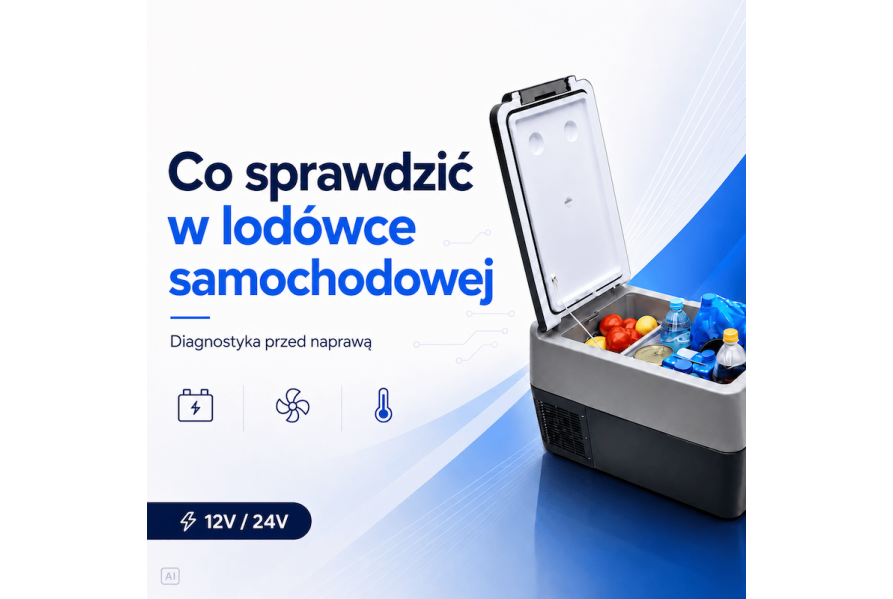
Car Refrigerator Not Cooling? What to Check Before Repair
Car refrigerator not cooling, compressor not starting or only the fan running? Find out what you can safely check before sending the refrigerator for repair - 12V/24V power supply, fuse, voltage during compressor start-up, control panel, temperature sensor and error codes.
A car refrigerator, portable refrigerator or truck refrigerator can stop cooling for many different reasons. Sometimes it does not switch on at all. In other cases, the light and control panel work, but the compressor does not start. You may also find that the fan is running while the temperature inside the refrigerator does not drop.
In these situations, it is not always immediately clear whether the problem is caused by the refrigerator itself, the vehicle electrical system, power supply, temperature sensor, control panel, compressor controller or refrigeration system.
Before sending the refrigerator to a service centre, it is worth carrying out a few basic checks. This does not mean repairing the electronics yourself or opening the refrigeration system. The purpose is to identify the symptoms, eliminate simple causes and collect useful information for further diagnostics.
If your 12V/24V refrigerator is not cooling, the compressor does not start or error codes are displayed, HESTA can assist with diagnostics and repair. We also provide repair and service of truck refrigerators for SCANIA, MAN, Mercedes, Volvo, Iveco, DAF and Renault.
Check car and truck refrigerator repair
The light is on - does this mean the power supply is correct?
No. This is a very common mistake when assessing a refrigerator fault.
An illuminated interior light, working display or active control panel only confirms that some voltage is reaching the refrigerator. It does not mean that the power supply is sufficient for the compressor to operate correctly.
A car refrigerator compressor requires a stable power supply, particularly during start-up. The panel, light or control electronics may continue to operate even when the vehicle installation is unable to deliver sufficient current to start the compressor.
Typical symptoms may include:
- the light is on, but the refrigerator is not cooling,
- the control panel works, but the compressor does not start,
- the refrigerator attempts to start and switches off shortly afterwards,
- the fan runs, but the compressor does not start,
- an LED flashes or an error is displayed,
- the refrigerator only works occasionally, for example when the vehicle engine is running.
For this reason, the fact that the light is on is not enough to confirm that the refrigerator has a correct power supply.
What can you check yourself in the power supply?
Before contacting a service centre, several basic checks can be performed. One of the most important is measuring the voltage not only with the refrigerator at rest, but also during an attempted compressor start.
A multimeter is required for basic electrical checks. If you do not have experience with electrical measurements, do not open electronic modules or measure in locations where an accidental short circuit could occur. In this case, it is better to limit the checks to simple observations or use professional assistance.
Check the following:
- battery voltage,
- voltage at the refrigerator power input,
- whether the voltage drops when the compressor attempts to start,
- condition of the fuse,
- condition of the power socket,
- condition of the power plug,
- whether any cables or connections are loose, corroded or overheated,
- whether the problem occurs on 12V, 24V, 230V or only with one power source,
- whether the refrigerator behaves differently with the vehicle engine running.
The voltage measurement during compressor start-up is particularly important. The voltage may appear correct without load but fall significantly when the compressor attempts to start. In this situation, the refrigerator may display an error, switch the compressor off or fail to start it at all.
If a truck refrigerator is not cooling and the problem occurs only when installed in the vehicle, the cause may be the vehicle wiring, power cable, ground connection, connector, fuse or voltage drop. The refrigerator itself is not necessarily faulty.
The fan is running, but the refrigerator is not cooling
A running fan also does not prove that the refrigerator is operating correctly. Two different situations should be distinguished.
The fan is running, but the compressor does not start
In this situation, the refrigerator may have power, the control panel may operate and the fan may run, but the refrigeration system does not actually start cooling.
Possible causes include low voltage under load, a compressor controller fault, temperature sensor problem, control panel fault, thermostat fault or a problem with the compressor itself.
The fan and compressor are running, but the temperature does not drop
This is a different diagnostic situation. If the compressor is genuinely running for an extended period but the refrigerator is still not cooling, possible causes include the refrigeration system, poor condenser ventilation, contamination, a faulty fan, refrigerant loss, a restriction in the system or another fault requiring service diagnostics.
In both cases, a precise description of the symptoms is useful. The statement "the fan is running" alone is not sufficient to determine the cause of the problem.
What should you check when the fan is running?
- can you hear the compressor starting,
- does the compressor continue running or only attempt to start,
- is there a click, change of sound or shutdown during the start attempt,
- does the fan start immediately when the refrigerator is switched on,
- does the fan run continuously or only briefly,
- is an LED flashing,
- is an error code displayed on the control panel,
- does the internal temperature actually fall after the refrigerator has been running for some time,
- does the condenser have sufficient ventilation,
- is the refrigerator installed in a location where air circulation is restricted.
The compressor does not start - possible causes
If the compressor in a car refrigerator does not start, do not immediately assume that the compressor itself is faulty. In many cases, the cause is elsewhere in the system.
- voltage drop during start-up,
- weak or discharged battery,
- damaged or undersized power cables,
- poor ground connection,
- damaged plug or power socket,
- corroded connectors,
- faulty compressor controller,
- control panel fault,
- thermostat fault,
- faulty temperature sensor,
- low-voltage protection activated by the controller,
- compressor overload,
- compressor failure.
In many 12V/24V refrigerators, a separate electronic controller is responsible for starting and controlling the compressor. If the controller detects a fault, fails to provide the correct drive signal or is itself damaged, the compressor may not start even though power is reaching the refrigerator.
In this situation, HESTA also provides 12V/24V refrigerator compressor controller repair.
Check 12V/24V compressor controller repair
Temperature sensor, control panel and compressor controller
A car refrigerator consists of much more than the compressor and cooling compartment. Electronic control components play an important role in modern refrigerators.
Components that may affect refrigerator operation include:
- temperature sensor,
- control panel,
- thermostat,
- compressor controller,
- fan,
- voltage protection circuits,
- wiring and connectors between individual components.
A faulty temperature sensor may provide an incorrect temperature reading. As a result, the refrigerator may fail to start, switch off too early or operate incorrectly.
A control panel fault may cause incorrect indications, no response to settings or failure to send the correct command to start cooling. A faulty compressor controller may prevent the compressor from starting or generate an error.
If you have a Waeco or Dometic refrigerator, first identify the exact model and details from the rating plate. HESTA provides Waeco refrigerator repair and Dometic refrigerator repair.
What can you check on the control panel, sensor and controller?
Without opening the electronics, you can check several basic symptoms:
- does the control panel switch on normally,
- do the buttons respond correctly,
- can the set temperature be changed,
- does the displayed temperature appear realistic,
- is an error code displayed,
- does an LED flash in a specific sequence,
- does the refrigerator respond when the set temperature is changed,
- does the problem occur immediately or only after some operating time,
- is the symptom the same with different power sources.
We do not recommend opening the compressor controller, soldering the electronics, randomly disconnecting wires or opening the refrigeration circuit. These actions can cause additional damage and make subsequent diagnostics more difficult.
Error codes, messages and flashing LEDs
Many car and portable refrigerators indicate a fault using an error code on the control panel, an error message or a flashing LED. This can provide useful diagnostic information, but it must be interpreted carefully.
Do not assume that E1, E3, E5 or another code always represents the same fault. Error code meanings depend on the manufacturer, refrigerator model, control panel, compressor controller and specific version of the appliance.
Before contacting the service centre, record:
- the exact error code displayed,
- the number of LED flashes,
- whether the LED flashes continuously or in groups,
- whether the error appears immediately after switching the refrigerator on,
- whether the error appears only when the compressor attempts to start,
- whether the same error occurs on 12V, 24V or 230V,
- the meaning of the error according to the manual for the exact refrigerator model.
If the manufacturer's manual includes an error code description, check it before contacting the service centre. An error code does not always identify one specific failed component. It may indicate a wider category of problems involving the power supply, compressor start-up, fan, sensor or electronics.
The refrigerator is running but not cooling - when should you suspect the refrigeration system?
If the control panel works, the fan runs and the compressor continues operating for an extended period, but the temperature inside the refrigerator does not fall, the fault may be related to the refrigeration system.
Possible causes include:
- insufficient condenser ventilation,
- dirty condenser,
- faulty cooling fan,
- very high ambient temperature,
- incorrect installation with insufficient airflow,
- refrigeration system fault,
- restriction in the refrigeration circuit,
- refrigerant loss,
- worn or damaged compressor.
Do not open the refrigeration system yourself, add unknown substances or interfere with the refrigerant circuit. Proper diagnosis of the refrigeration system requires suitable equipment, knowledge and workshop conditions.
What should you prepare before contacting the service centre?
Providing a few basic details can make the initial diagnosis significantly easier.
Prepare the following information:
- refrigerator brand,
- exact model,
- photo of the rating plate,
- whether the refrigerator operates on 12V, 24V, 230V or several power sources,
- precise description of the fault,
- whether the light and control panel work,
- whether the fan is running,
- whether the compressor starts,
- error code or number of LED flashes,
- voltage measured at the refrigerator input,
- voltage measured during an attempted compressor start.
Example fault description:
This type of description is much more useful than simply stating that "the refrigerator does not cool".
Need remote assistance?
If you need help organising the symptoms and carrying out basic checks before sending the refrigerator for repair, you can use HESTA's paid remote assistance for portable and car refrigerators operating on 12V and 24V.
Remote assistance can help determine whether the problem may be related to the vehicle installation, power supply, battery, wiring, compressor controller, thermostat, temperature sensor, control panel or the refrigerator itself.
Basic measuring equipment is required, primarily a multimeter, together with access to the refrigerator power supply and installation.
Remote assistance does not replace full workshop diagnostics, but it can help organise the symptoms, perform basic measurements and determine whether the refrigerator should be sent for repair.
When should the refrigerator be sent for repair?
The refrigerator should be professionally diagnosed when:
- the power supply has been checked but the refrigerator still does not start,
- the compressor does not start despite correct voltage,
- error codes repeatedly appear,
- the controller LED flashes in a repeatable sequence,
- the control panel operates incorrectly,
- the refrigerator starts only for a short time,
- the fan runs but the compressor does not start,
- the compressor runs but the refrigerator does not cool,
- you suspect a fault in the compressor controller, electronics or refrigeration system.
The refrigerator can be delivered to the HESTA service centre in Radom, Poland, or sent by courier. For international shipments, pack the refrigerator securely and include the model details and a clear description of the fault.
Summary
If a car refrigerator does not cool, does not start or only works intermittently, basic diagnostics should begin with the power supply. An illuminated light, working control panel or running fan does not necessarily mean that the compressor is receiving the correct conditions for start-up.
Check the voltage at the refrigerator power input and, if possible, measure it while the compressor attempts to start. Also record the symptoms, error code, number of LED flashes, refrigerator model and information from the rating plate.
If these basic checks do not identify the cause of the problem, the refrigerator should be professionally diagnosed. HESTA repairs car refrigerators, portable refrigerators and truck refrigerators, including selected Waeco and Dometic models and 12V/24V compressor systems.